PHARMARECALL™ GENERAL PHARMACOLOGY
Rapid Revision Pack — Volume 1 Learn it. Recall it. Apply it. Pass it. Designed for MBBS, Pharmacy, Nursing and other Health-Science students. Inside: 30 active-recall cards • 30 MCQs • 20 Exam Pearls • High-yield pharmacokinetic/pharmacodynamic concepts Educational use only. Verify clinical information against current authoritative pharmacology references before clinical application.
How to Use PharmaRecall
Cover the answer, attempt the question, then reveal and explain it in your own words. Revisit difficult cards at increasing intervals. For MCQs, identify why each incorrect option is wrong.
Recommended cycle: Recall → Check → Explain → Apply → Repeat. Part 1 — 30 Recall Cards
CARD 01 — Pharmacology Q: What is pharmacology? A: The science concerned with drugs and their interactions with living systems.
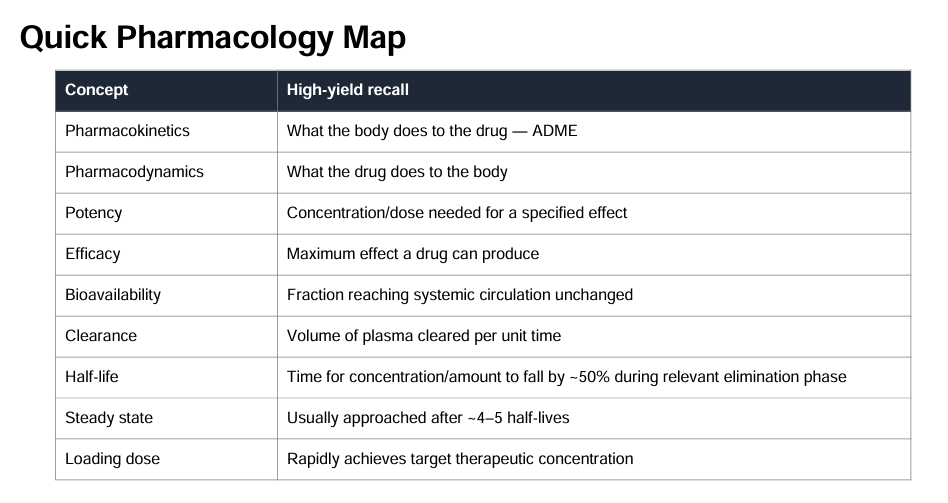
CARD 02 — Pharmacokinetics Q: What does pharmacokinetics describe? A: What the body does to the drug: absorption, distribution, metabolism and excretion (ADME).
CARD 03 — Pharmacodynamics Q: What does pharmacodynamics describe? A: What the drug does to the body, including effects produced through molecular and physiological mechanisms.
CARD 04 — Receptor Q: What is a receptor? A: A macromolecular component that binds a ligand/drug and initiates a cellular response.
CARD 05 — Full Agonist Q: What is a full agonist? A: A ligand with affinity for a receptor that can produce a maximal response in the system under consideration.
CARD 06 — Partial Agonist Q: What is a partial agonist? A: A ligand that activates a receptor but produces less than the maximal response even with extensive receptor occupancy.
CARD 07 — Competitive Antagonist Q: What is a competitive antagonist? A: A drug that competes with an agonist for the same receptor site and, when surmountable, can be overcome by increasing agonist concentration.
CARD 08 — Potency Q: What is drug potency? A: The amount or concentration required to produce a specified effect. Lower EC50 generally indicates greater potency.
CARD 09 — Efficacy Q: What is drug efficacy? A: The maximum effect a drug can produce in a given system
CARD 10 — Therapeutic Index Q: What does therapeutic index broadly express? A: A comparison of toxic and effective dose/exposure; a wider margin generally indicates a wider safety margin.
CARD 11 — Therapeutic Window Q: What is the therapeutic window? A: The range between the minimum effective exposure and the minimum toxic exposure.
CARD 12 — Bioavailability Q: What is bioavailability? A: The fraction of an administered dose that reaches systemic circulation unchanged. IV administration has complete systemic bioavailability.
CARD 13 — First-pass Effect Q: What is the first-pass effect? A: Presystemic metabolism of an orally administered drug in the gut wall and/or liver before it reaches systemic circulation.
CARD 14 — Volume of Distribution Q: What does apparent volume of distribution indicate? A: A proportionality factor relating the amount of drug in the body to plasma concentration; it is not necessarily a true anatomical volume.
CARD 15 — Clearance Q: What is drug clearance? A: The volume of plasma from which drug is completely removed per unit time.
CARD 16 — Half-life Q: What is elimination half-life? A: The time required for plasma concentration or amount of drug to decrease by approximately 50% during the relevant elimination phase.
CARD 17 — Steady State Q: When is steady state typically approached during repeated dosing? A: After about 4–5 elimination half-lives for drugs with first-order elimination.
CARD 18 — Loading Dose Q: Why is a loading dose used? A: To achieve a target therapeutic concentration more rapidly, especially when the drug has a long half-life.
CARD 19 — Maintenance Dose Q: What is the purpose of a maintenance dose? A: To replace drug eliminated from the body and maintain the desired therapeutic exposure.
CARD 20 — First-order Elimination Q: What characterises first-order elimination? A: A constant fraction of drug is eliminated per unit time; the elimination rate changes with concentration.
CARD 21 — Zero-order Elimination Q: What characterises zero-order elimination? A: A constant amount of drug is eliminated per unit time, often because elimination pathways are saturated.
CARD 22 — Enzyme Induction Q: What is enzyme induction? A: Increased expression/activity of drug-metabolising enzymes, which can lower concentrations of affected drugs.
CARD 23 — Enzyme Inhibition Q: What is enzyme inhibition? A: Reduced metabolic activity of an enzyme, which can increase concentrations and toxicity of affected substrates.
CARD 24 — CYP3A4 Q: Why is CYP3A4 clinically important? A: It metabolises many drugs and is a major source of drug–drug interactions through induction or inhibition.
CARD 25 — Adverse Drug Reaction Q: What is an adverse drug reaction? A: A harmful and unintended response to a medicine occurring at normal doses used for prevention, diagnosis or treatment.
CARD 26 — Tolerance Q: What is pharmacological tolerance? A: A reduced response to a drug after repeated exposure, so a larger dose may be needed to produce the original effect.
CARD 27 — Physical Dependence Q: What is physical dependence? A: A state in which abrupt reduction or cessation of a drug can produce a withdrawal syndrome.
CARD 28 — Idiosyncratic Reaction Q: What is an idiosyncratic drug reaction? A: An unusual, unpredictable reaction not readily explained by the drug’s usual pharmacological action and reflecting individual susceptibility.
CARD 29 — Pharmacovigilance Q: What is pharmacovigilance? A: The science and activities concerned with detecting, assessing, understanding and preventing adverse effects and other medicine-related problems.
CARD 30 — Drug Interaction Q: What is a clinically important drug interaction? A: A change in a drug’s effect or exposure caused by another drug, food, disease or other factor that may alter benefit or risk.
Part 2
30 MCQs Choose the single best answer before checking the key.
1. Pharmacokinetics is primarily concerned with: A. What the drug does to the body B. What the body does to the drug C. Drug receptor structure only D. Drug manufacturing Answer: B
2. Pharmacodynamics is primarily concerned with: A. Absorption only B. Excretion only C. What the drug does to the body D. Drug packaging Answer: C
3. Which route provides complete systemic bioavailability? A. Oral B. Subcutaneous C. Intramuscular D. Intravenous Answer: D
4. A drug with a high first-pass effect may have: A. Increased oral bioavailability B. Reduced oral bioavailability C. No metabolism D. Complete renal excretion unchanged Answer: B
5. Which measure is most closely associated with potency? A. Emax B. EC50 C. Clearance D. Half-life Answer: B
6. Efficacy is most closely related to: A. Maximum effect B. Dose absorbed C. Rate of renal filtration D. Protein binding only Answer: A
7. A partial agonist can: A. Produce the same maximal effect as a full agonist in every system B. Produce less than maximal response despite receptor occupancy C. Never bind receptors D. Only act as an enzyme inhibitor Answer: B
8. A competitive antagonist generally causes a surmountable agonist dose-response curve to shift: A. Left with increased Emax B. Right without reducing Emax C. Down with no change in potency D. Randomly Answer: B
9. A large apparent volume of distribution generally suggests that a drug: A. Remains mainly in plasma B. Is extensively distributed outside plasma C. Cannot enter tissues D. Is always highly water-soluble Answer: B
10. Clearance is expressed conceptually as: A. Time to peak concentration B. Volume of plasma cleared of drug per unit time C. Total dose administered D. Maximum effect Answer: B
11. For many drugs showing first-order elimination, steady state is approached after approximately: A. 1 half-life B. 2 half-lives C. 4–5 half-lives D. 20 half-lives Answer: C
12. A loading dose is primarily used to: A. Prolong absorption B. Reach therapeutic concentration rapidly C. Prevent all adverse effects D. Increase renal clearance Answer: B
13. Which statement about first-order elimination is correct? A. A constant amount is removed per unit time B. A constant fraction is removed per unit time C. Elimination is always saturated D. Half-life changes dramatically with concentration in all cases Answer: B
14. Zero-order elimination means: A. Constant fraction eliminated per unit time B. Constant amount eliminated per unit time C. No drug is eliminated D. Drug is eliminated only by kidneys Answer: B
15. Enzyme induction may result in: A. Increased concentration of every drug B. Reduced concentration of affected substrate drugs C. Immediate receptor blockade D. Increased bioavailability of every oral drug Answer: B
16. Enzyme inhibition may result in: A. Reduced substrate drug concentration in all cases B. Increased substrate drug exposure and toxicity C. Faster drug synthesis D. No interaction Answer: B
17. Which enzyme is responsible for metabolism of many clinically used drugs? A. CYP3A4 B. Amylase C. Pepsin D. Carbonic anhydrase Answer: A
18. An adverse drug reaction is best described as: A. Any therapeutic effect B. A harmful and unintended response at normal doses C. A dispensing error only D. Drug expiry Answer: B
19. Tolerance refers to: A. Increased response after one dose B. Reduced response after repeated exposure C. Allergy in every patient D. Complete absence of metabolism Answer: B
20. Physical dependence is characterised by: A. Withdrawal after abrupt cessation/reduction B. Guaranteed addiction C. Increased bioavailability D. Increased renal excretion Answer: A
21. Pharmacovigilance is primarily concerned with: A. Drug advertising B. Detection and prevention of medicine-related harms C. Tablet colour D. Hospital architecture Answer: B
22. A drug with a small therapeutic window generally requires: A. No monitoring B. Greater attention to dosing and monitoring C. Unlimited dosing D. No consideration of interactions Answer: B
23. Which statement about IV administration is correct? A. It undergoes obligatory first-pass hepatic metabolism B. Systemic bioavailability is complete C. Absorption is always slow D. It cannot produce toxicity Answer: B
24. A drug’s half-life is most directly related to its: A. Clearance and volume of distribution B. Tablet colour and taste C. Receptor number only D. Dose form only Answer: A
25. If clearance decreases substantially while dosing remains unchanged, drug exposure will generally: A. Decrease B. Increase C. Become zero D. Be unaffected in all circumstances Answer: B
26. Which is most likely to increase the duration of a drug effect? A. Increased clearance B. Reduced elimination C. Increased metabolism D. Reduced bioavailability in every case Answer: B
27. A receptor antagonist with no intrinsic activity is best described as having: A. Affinity without efficacy B. Efficacy without affinity C. No receptor interaction D. Maximal efficacy Answer: A
28. A drug that induces metabolism of an oral contraceptive may cause: A. Increased contraceptive exposure B. Reduced contraceptive exposure and possible loss of efficacy C. No interaction D. Guaranteed toxicity Answer: B
29. A drug’s free concentration may be altered by: A. Changes in protein binding B. Tablet shape only C. Colouring agents only D. Room temperature alone Answer: A
30. Which statement best describes pharmacology? A. Study of drugs and their interactions with living systems B. Study of anatomy only C. Study of hospital administration D. Study of food chemistry only Answer: A
Part 3 — 20 Exam Pearls
01. Pharmacokinetics = what the body does to the drug.
02. Pharmacodynamics = what the drug does to the body. 03. ADME = absorption, distribution, metabolism, excretion.
04. IV administration gives complete systemic bioavailability.
05. First-pass metabolism can reduce oral bioavailability.
06. Potency is related to the concentration/dose needed for a specified effect.
07. Efficacy refers to the maximum effect a drug can produce.
08. EC50 is a commonly used measure of potency.
09. Emax is a measure of maximal effect in a dose-response system.
10. Partial agonists have lower maximal efficacy than full agonists in the same system.
11. Competitive antagonism can often be overcome by increasing agonist concentration.
12. Apparent Vd is a proportionality factor, not necessarily a real anatomical volume.
13. High Vd often reflects extensive tissue distribution.
14. Clearance describes removal of drug from plasma per unit time.
15. Steady state is commonly approached after about 4–5 half-lives.
16. A loading dose is used to reach a target concentration rapidly.
17. First-order elimination removes a constant fraction per unit time.
18. Zero-order elimination removes a constant amount per unit time.
19. Enzyme induction can reduce concentrations of affected substrate drugs.
20. Enzyme inhibition can increase concentrations of affected substrate drugs.